GUEST FEATURE: Beyond the Party Badge: Youth at UNCCD COP17
The National Environmental Youth Council of Mongolia (NEYC) is an independent, fully volunteer-based civil society organization (CSO), composed of Mongolian youth aged 18-35 in the environmental field. We approached COP17 with the objective of creating opportunities for young people to connect, organize, and contribute to the wider discussion around land and environmental governance.
by Bilguun Adiya
7 Oct, 2026
For many young people working on climate and environmental issues, the United Nations Framework Convention on Climate Change (UNFCCC) and its annual Conference of Parties (COPs) are the main international spaces on which they focus. The UN Convention to Combat Desertification (UNCCD) and its COPs are relatively less well known outside environmental policy circles.
For young people in Mongolia, however, the issues discussed under the UNCCD — such as land degradation, drought, and water security — are closely tied to our livelihoods, ecosystems, and the future of rural communities. These issues are increasingly difficult to separate from climate change. This made UNCCD COP17 especially relevant for Mongolian youth. It was an opportunity to bring these experiences into an international space and to connect with people working on similar challenges in other parts of the world.
The National Environmental Youth Council of Mongolia (NEYC) is an independent, fully volunteer-based civil society organization (CSO), composed of Mongolian youth aged 18-35 in the environmental field. We approached COP17 with the objective of creating opportunities for young people to connect, organize, and contribute to the wider discussion around land and environmental governance.
A space of our own
In Mongolia, youth consultations have created opportunities for young people who cannot attend international conferences to contribute their perspectives. The findings from these consultations have been shared with both YOUNGO and the UNCCD Youth Caucus, helping connect national youth perspectives with international youth networks.
We hosted a dedicated Youth Booth in the Green Zone, which was our way of bridging this divide, and it became a base for national youth engagement throughout the conference. Through a public call, we granted other local youth organizations access to host events at the Youth Booth on an organized schedule. The Blue Zone is officially international territory with the UN flag waving during the conference, whereas the Green Zone is host country territory which does not require any special access. Since NEYC’s activities were heavily centered in the Blue Zone, this one event in the Green Zone was a tremendous opportunity for many.
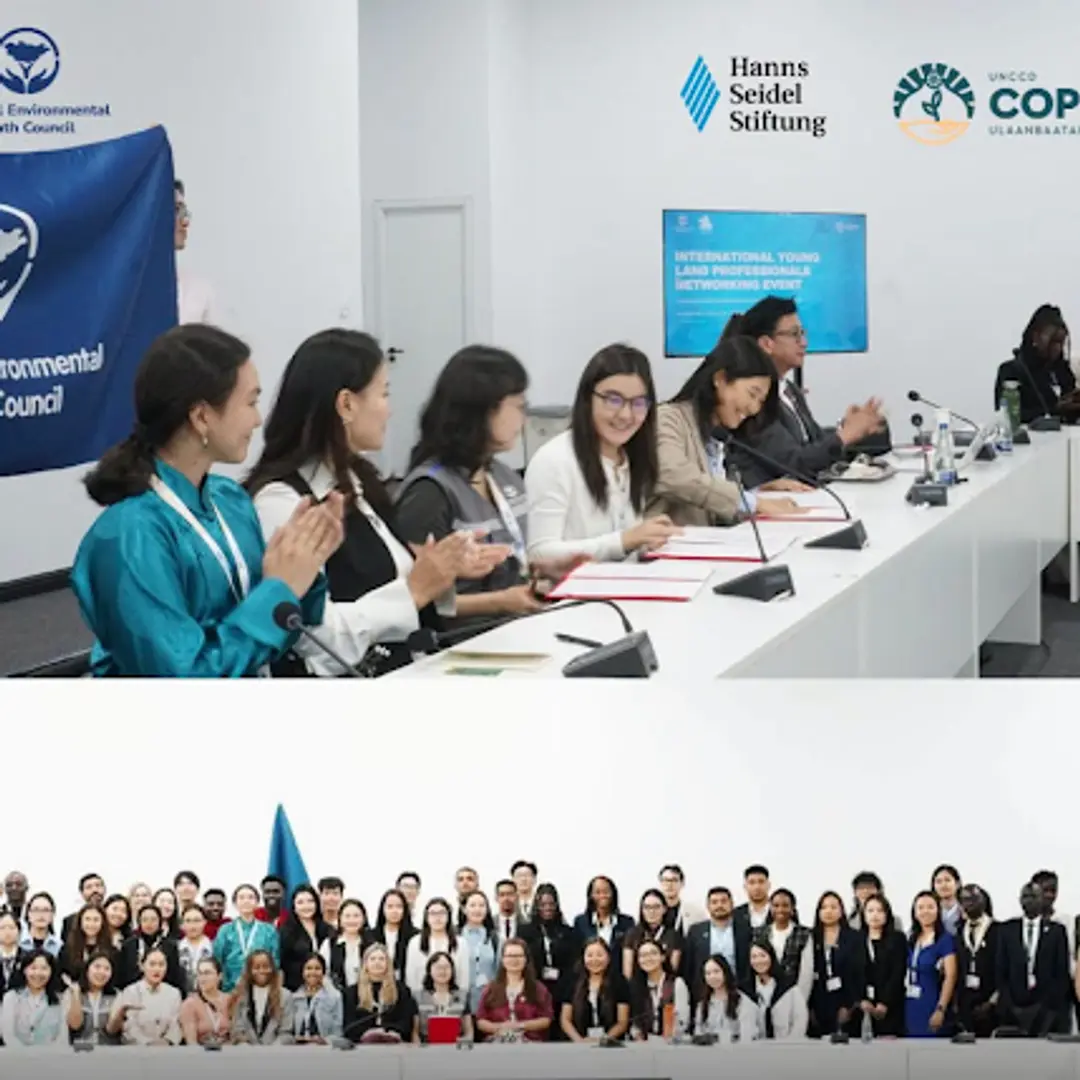
On the first day in the Blue Zone, we organized the International Young Land Professionals Networking Event. This side event brought together young people from land-related fields and created an informal space for conversations that might have been otherwise difficult to have during a packed conference schedule. Young participants from different professional and national backgrounds were working on interconnected issues: land restoration, drought resilience, agriculture, environmental policy, and community engagement. During this event, our council announced the establishment of the Mongolian Youth Climate Alliance, a synergy possible largely due to the networking opportunities presented at COP17.
Supporting youth leadership
The second and third days focused on the Youth Forum, which we co-organized with the UNCCD Youth Caucus. Our role included significant on-the-ground support for the organization and delivery of the forum. Working alongside the Youth Caucus gave us the opportunity to contribute to an international youth space while also learning from young people involved in the UNCCD process from different regions. The experience reinforced the importance of youth networks within COP. While young people often arrive from different national contexts, many face similar challenges in turning their ideas into impacts.
Unfortunately, many young people were spread too thin across numerous commitments. Our council members were all volunteers juggling work commitments on top of our contribution to the cause. Many other youth were only able to attend COP as part of their national delegation. While this is a great indicator of youth inclusion, it means that those young people have less freedom to express their own thoughts, as they are so busy with Party negotiations.
The Youth Forum provided space to discuss these questions collectively and to strengthen connections between young people working on land and environmental issues. It was inspiring for us to learn how youth in African nations found their common ground to establish continent-wide networks, just as it was inspiring for other countries to hear about the resilience of Mongolian young pastoralists.
Bringing Mongolia’s civil society perspective into the Blue Zone
Youth engagement at COP17 extended beyond explicitly youth-focused activities. In the Blue Zone, we co-organized “The Role of Civil Society Organizations in Driving UNFCCC and UNCCD Synergies: A Perspective from Mongolia” with Breathe Mongolia, youth-founded and youth-led ally of our council, amongst other partners.
The discussion focused on an issue that is particularly relevant from the Mongolian perspective: the need to connect international environmental processes that often address closely related problems. At the community level, climate change, drought, land degradation, and water insecurity are experienced together. International institutions may approach these issues through different conventions, but CSOs often work across these boundaries.
For Mongolia, civil society can play an important role in bringing local experiences into international conversations and in translating international commitments into national advocacy. The Blue Zone event therefore gave us an opportunity to contribute a Mongolian perspective to a wider discussion about the relationship between the UNFCCC and UNCCD.
Who gets to participate?
COP17 made clear the practical limits of youth participation. Different accreditation categories provide different levels of access within the conference. Many civil society participants, including young people, can take part in Blue Zone side events, forums, and public discussions, but cannot access formal negotiation spaces where Parties make decisions. This makes the spaces around the negotiations especially important, and highlights the need for a stronger connection between these spaces and the formal process.
Furthermore, the cost of getting to a COP presents a logistical hurdle for youth participation. For Mongolian youth organizations, international participation can involve long-distance travel, visas, accommodation, and other expenses. Mongolia’s geographic location means that simply reaching an international conference can be a significant barrier. Supporting youth participation therefore involves more than providing a programme or accreditation. Travel support, information, capacity-building, and opportunities for continued engagement all affect whether young people can participate meaningfully.
What comes after COP17?
The most interesting part of COP17 will ultimately be what happens after everyone leaves. The value of the Youth Booth will be measured partly by the relationships built there. The value of the Young Land Professionals event will be reflected in whether those connections continue. The Youth Forum matters because the conversations and networks developed through it can continue to strengthen youth engagement within the UNCCD process.
For Mongolian youth, COP17 has also provided an opportunity to bring greater international attention to issues that are already important at home, while learning from experiences elsewhere. The conference has shown that there are many ways for young people to contribute: organizing events, building professional networks, supporting international youth constituencies, engaging civil society, and bringing national perspectives into global discussions.
Our main message targeting the governments, particularly our own which is now the UNCCD Presidency, has been and will continue to be the importance of sustainably providing youth a platform to speak and contribute. We need continued and sustainable opportunities for participation and inclusion.
Young people will live with the long-term consequences of decisions on land, drought, and environmental resilience, and as such should therefore have a sustained role in discussions about how those challenges are addressed. COP17 has provided a space for that engagement. The challenge now is to carry that work forward.
ABOUT THE AUTHORBilguun Adiya is a Board Member and Policy Advocacy Lead at the National Environmental Youth Council of Mongolia. He is also a full-time lecturer in environmental law at the School of Law of the University of Finance and Economics of Mongolia. Bilguun has earned a Master of Laws (LL.M.) in Energy and Environmental Law degree from the George Washington University Law School on the Fulbright Foreign Student Scholarship.
References
Related Articles
A look into UNFCCC Climate Week 4: From Ambition to Implementation on the way to COP31
Two Crises, One Source: How are Fossil Fuel Lobbyists Delaying the UN Global Plastics Treaty Talks?
Climate And Security in the Pacific: The Australia-Tuvalu Falepili Union Deal
The Price of Climate Diplomacy: Why the UNFCCC Funding Crisis Matters