Why food belongs in climate policy discussions
Q1. Food systems are increasingly recognised as an important part of climate action, but they still receive relatively little attention in climate-policy discussions. Why do food systems need to be part of the climate conversation?
Spanning land-use change, agricultural production, processing, transport, consumption and waste, food systems drive roughly a third of global emissions (Crippa et al. 2021). Food systems simultaneously offer some of the fastest mitigation options available whilst being among the sectors most vulnerable to climate impacts. Despite this, food systems are chronically underfunded, under-addressed in national climate plans, and marginal in climate negotiations. Where food does appear, coverage is insufficient. Few countries support demand-side policies on food consumption, despite independent global climate experts of the IPCC considering the mitigation potential as at least as significant as supply-side.
The bottom line: food systems cause too large a share of emissions, are too central to adaptation and food security, and are too promising a source of fast mitigation – something we urgently need, as demonstrated by the most recent overshoot report from UNEP (UNEP, 2026) – to keep treating them as a secondary issue.
Q2. Food-related climate policies tend to focus on adapting animal agricultural systems to cope with climate change, rather than reducing over-consumption of animal products. Why is shifting towards more plant-rich diets a policy issue, rather than simply a matter of individual consumer choice?
Plant-rich eating is a policy issue because it’s the output of a food environment that is actively shaped by policies. Currently, prices are heavily influenced by subsidies that favor meat and dairy over plant-based alternatives or whole foods, such as legumes, vegetables, fruits and whole grains. Externalities like emissions and land use are not priced in, so animal products stay artificially cheap while their true cost is hidden. Availability, marketing, and what is on offer in shops, canteens and public procurement steer what feels “normal” and convenient to eat.
Individual choice sits at the end of this chain, not the start. If pricing, procurement rules, and product availability keep favoring animal products, asking individuals to choose differently ignores the structure they’re choosing within. This is where making plant proteins genuinely appealing, accessible and affordable matters: rebuilding those foundations is what allows plant-rich options to become the default, easy choice.
ProVeg and International Climate Policy
Q3. Could you tell us a little about ProVeg’s work within international climate policy, particularly through the UNFCCC and other UN processes? What are you trying to achieve at this level?
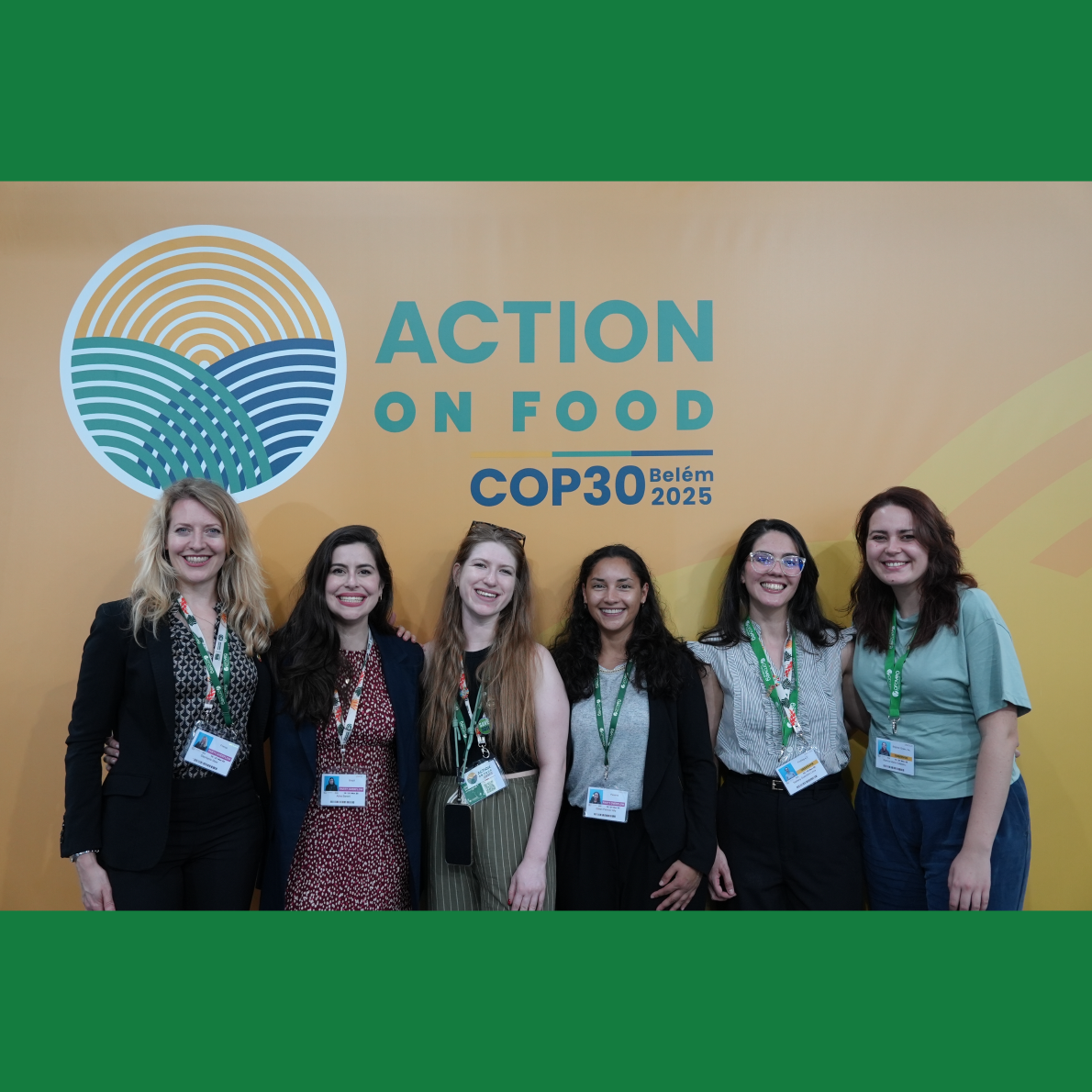
ProVeg International has spent years building formal standing in UN climate processes, gaining permanent UNFCCC observer status at the end of 2019 and early advocacy dating back to COP23 in Bonn. Most recently, ahead of COP30, ProVeg launched the Belém Declaration on Plant-Rich Diets, signed by over 100 stakeholders, including civil society and local and national policymakers, urging governments to adopt National Action Plans for Plant-Based Foods, modeled on Denmark’s 2023 Action Plan. With the Belém Declaration, we are aiming to send a public signal to governments that such Action Plans are needed worldwide, and we are ready to support governments to develop these plans in line with their national priorities.
Alongside this, ProVeg, Climate Focus and WWF released the Diets Toolkit at COP30. This step-by-step guide provides a practical menu of country-adaptable policies (plant-based options in public institutions, revised dietary guidelines, targeted subsidies) to embed diets into NDCs and biodiversity plans.
One of the main objectives of our international advocacy is to bring case studies or best practices that can be replicated in other contexts to the UNFCCC and other UN processes. Our policy recommendations are closely developed in collaboration with our national and EU offices and based on real time challenges and issues.
Q4. Can you give us an overview of global food systems negotiations at the moment?
As mentioned, food systems still receive little attention in comparison to other topics. There are, however, sustained, formal UNFCCC processes with ties (direct or indirect) to agriculture. For instance we have contributed to a range of negotiation streams, including the Koronivia Joint Work on Agriculture, the Global Stocktake, the Mitigation Work Programme, the Global Goal on Adaptation, and the Sharm el-Sheikh joint work on agriculture and food security (called the SJWA amongst ourselves).
The SJWA is the current stream of agriculture negotiations under the UNFCCC (see this ClimaTalk factsheet). One would hope this could create a real opportunity for progress to ensure how we produce and consume food is aligned with the global climate goals. Instead, the negotiations have faced repeated challenges, with Parties disagreeing on topics including mitigation and adaptation needs, finance, equity, and more. Food systems are tied into all of the above adjacent negotiation strands, however, negotiations often reduce this complex issue to agricultural production alone. The main opportunity for us lies in the fact that this topic is complex and a clear roadmap does not yet exist – there is a clear need for us to engage and push for future resilient food systems. The future of food systems may be fraught with challenges and complexities, but it is open.
Q5. One of ProVeg’s most visible examples of this work has been your campaigning for more sustainable, plant-based catering at UN climate conferences. Could you take us through how that campaign developed? What does it actually take to change the food served at an event as large and complex as COP?
COP Presidencies rotate every year and therefore, the new Host Country always has different regulations, laws and priorities in place. This makes advocacy for sustainable plant-based catering even harder.
What it takes at COP scale: a broad coalition to get behind a common ask, direct engagement with each year’s rotating host Presidency (since caterers, culture and supply chains change), and practical tools caterers can actually use – plus patience and perseverance!
The campaign built gradually: Food@COP (a youth-led UNFCCC initiative under YOUNGO), supported by ProVeg, first pushed for climate-friendly catering at COP26 and COP27. Ahead of COP28, ProVeg and Food@COP sent a joint letter backed by 140+ organisations asking for at least three-quarters plant-based options; the UAE Presidency agreed and COP28 served a “1.5°C-aligned menu” that was roughly two-thirds vegan/vegetarian. COP30’s organisers committed to a 40% target and ProVeg Brazil’s own audit found they exceeded it at 51.2%.
ProVeg launched our catering guide, Future Plates, at the UN’s Bonn Climate Meetings in mid-2025, aimed at caterers providing the food served at UN and other international climate events. It gives caterers practical arguments, best practices, case studies from large-scale events like the Paris Olympics, and recipes.
An integration in the Host Agreement (signed between the UNFCCC and the COP Presidency) regarding sustainability requirements for catering would prominently facilitate our advocacy. Ideally this would incorporate criteria pushing for default plant-based options or low-emissions catering.
Q6. ProVeg works with several other constituencies or organisations to push forward on the international policy front – which of these partnerships have proven significant in pushing forward your work on sustainable catering at COPs, for instance?
Successes often come with collaboration. One of ProVeg’s most active partnerships is the Food & Climate Action Group, which is an independent coalition of 25+ international NGOs advocating for food-systems transformation within the UNFCCC, spanning expertise in food awareness, climate, environment, sustainability, animal welfare and health, with members active across both the Global North and Global South. Aside from collaborative work on catering, the coalition track record shows sustained, formal UNFCCC engagement via submissions to a range of negotiation streams, discussed above (including the SJWA).
This kind of cross-collaboration is a deliberate strategic choice: It builds community, pools different expertises, and it signals a breadth of consensus on the need to transform our food system. Especially on the UN stage, it can be tough as a single NGO to have your voice and perspective heard. It is essential to collaborate with others, to align your positions. Sometimes it means compromising on smaller things. As long as your central mission and values are aligned, this is a net positive – we all want sustainable and resilient food systems, we just have different lenses on what it means.
What can our young readers take away from this?
ProVeg has a fantastic Youth Board, but besides considering applying for this, you have plenty of resources young people could utilise to push for change within their communities.
Q7. How can young people encourage their workplaces or universities to become more plant-forward?
The ProVeg Youth Board is a global group of young changemakers working closely with ProVeg’s UN team and using their voice both at UN-level and within their own countries to push for a shift toward a more plant-based food system.
Getting to foundations, earlier this year, the Youth Board released its own cookbook, a resource made by and for young people who want to push for change starting from their own plates. Every recipe carries a personal story: memories of home, cultural traditions or moments that connect food to identity – all linked together with interviews where board members talk about their motivations for embracing plant-rich diets. It’s a good example of the board’s work outside formal negotiations: building community and making plant-rich eating feel personal and culturally grounded, rather than only policy-focused.
The Future Plates guide mentioned earlier could also be a great support to share with universities or bigger institutions. They could also get in touch with Plant-Based Universities, which is not linked to ProVeg, but shares the same mission. A simple outreach to ProVeg for resources or support is also something possible! While our teams are working on a lot of different projects, we might be able to provide further assistance with more context.
RESOURCES:
The team has recommended the following resources to young people wanting to understand or advocate for more plant-rich food systems:
Future Plates – A catering guide for large scales event
Food System Data
Planetary Plates Network (for school meals advocacy)
The Diets Toolkit for NDCs and NBSAPs
ProVeg Talks (Podcasts)
Key Youth Demands (developed ahead of COP30)
The Belém Declaration on Plant-Rich Diets (continuously open for endorsements)
Food & Climate Action Group
Plant-Based Universities
ClimaTalk SB64 Factsheet: Food and Agriculture
ClimaTalk COP30 Factsheet: Food and Agriculture
ClimaTalk SB62 Factsheet: Food and Agriculture
Sharm el-Sheikh Joint Work on Climate Action for Agriculture and Food Security