Cities are home to more than half of the world’s population and generate 80% of global GDP [1]. Therefore, making cities more resilient to the impacts of the climate crisis is critical to a sustainable future. This is not a future concern but an immediate one, as last summer’s many climate disasters show [2]. At the same time, cities generate 70% of global emissions, making them not only a key area for adaptation but also for mitigation [3]. But what does it mean for a city to be ‘resilient’? And what role do international climate change negotiations such as COP31 play? This article will explore these questions.
What is urban resilience?
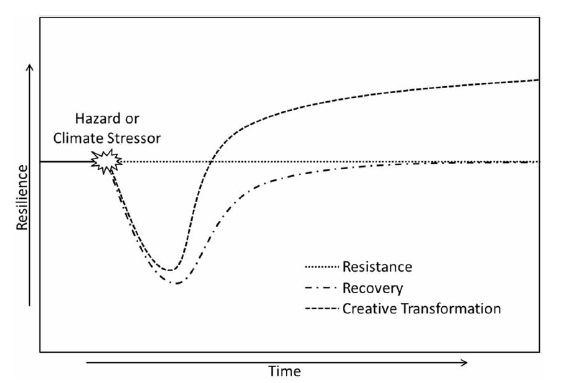
The NGO Resilient Cities Network defines urban resilience as “the capacity of individuals, communities, institutions, businesses and systems within a city to survive, adapt and grow no matter what kinds of chronic stresses and acute shocks they experience”, with chronic stresses including sea level rise and rising temperatures, and acute shocks including floods, droughts, and heatwaves [4, 5]. In literature, resilience has been interpreted in a number of ways, as shown in the figure below:
- Resilience as resistance: capacity to resist and absorb climate impacts;
- Resilience as recovery: capacity to recover from climate impacts;
- Resilience as creative transformation: capacity to not only recover from climate impacts, but learn from them and adapt [6].
There are several ways urban design can contribute to enhancing urban resilience.
Greening urban spaces reduces the urban heat island effect, where narrow streets and concrete structures trap heat, making cities several degrees warmer than the surrounding countryside. Greening causes evaporation and provides shade, making cities more resilient to rising temperatures and heatwaves [7, 8].
Using porous materials for streets reduces the buildup of water, making cities more resilient to floods [9]. Water reservoirs can store water, enhancing resilience against droughts [9]. Coastal sand dunes can help protect coastal cities and increase their resilience to sea level rise [10].
COP31 Action Agenda
‘Climate-resilient cities’ is one of the ten priority themes at COP31, with four core focus areas:
- Reducing lifecycle emissions of buildings;
- Promoting green building certification;
- Mobilising capital for low-carbon infrastructure investments; and
- Scaling up norms that protect urban systems against extreme weather events and long-term climate risks [11].
Within this framework, the Presidency announced two new proposals:
- Reducing energy consumption intensity in the building sector by at least 25% by 2035 [12];
- The Sustainable Urban Resilience Financing (SURF) instrument, developed by Türkiye’s state-owned Development and Investment Bank (ILBANK), to help cities build capacity to develop projects and access finance [13].
From global to local
There have been several events on urban resilience in the lead-up to COP31. These focused on exchanging information and lessons learned, discussing issues and the role of COP31 [14, 15, 16]. One such event, Türkiye’s “Road to COP31: Resilient Cities Regional Forum”, was held in Hatay on 8-9 May 2026. It brought together ministers, including the COP31 President, international organisations, local authorities, financial institutions, academia, civil society and development partners, and was organised under the COP31 vision of “Dialogue – Consensus – Action”. At the end, the Hatay Declaration was adopted as input for COP31 and included the following commitments:
- Advancing climate-resilient urban transformation,
- Scaling up financing through blended and climate finance instruments,
- Accelerating urban energy transition, and
- Promoting nature-based solutions [14].
The Declaration emphasised that we need to move “from policy to implementation, from recovery to transformation, and from global commitments to local action” [14]. So how can COP31 achieve that?
One of the strengths of a COP is its ability to bring together a wide range of stakeholders from across the globe. It thus provides an excellent opportunity for strengthening international cooperation and exchanging solutions and opportunities. Cities can then translate and implement these solutions at the local level [14]. Cities can also use COP31 as a platform to communicate their needs and barriers. Cities can indicate — to financial institutions, for example — what they are struggling with and what they actually need, such as access to and the quantity of finance [16]. To support cities in meeting those needs, the SURF instrument can strengthen their institutional capacity to create bankable projects and attract more investment [13].
In addition, the target of reducing energy consumption intensity in the building sector by 25% by 2035 can galvanise stakeholders to work towards that target on a city level. Such targets can trickle down from the national to the local level [14, 16].
Conclusion
Increasing climate impacts and rural-to-urban migration are creating a dangerous cocktail for cities. COP31 offers a timely opportunity to spotlight urban resilience [1, 2]. The discussions should hopefully strengthen the capacity of cities, increase their knowledge and attract more much-needed finance. COP31 President and Türkiye’s Minister of Environment, Urbanisation and Climate Change Murat Kurum stated that they aim to make urban resilience “one of the main priorities of the global climate agenda at COP31” [14]. Come November, all eyes will be on Antalya to see if they can deliver on this promise.