

Energy production
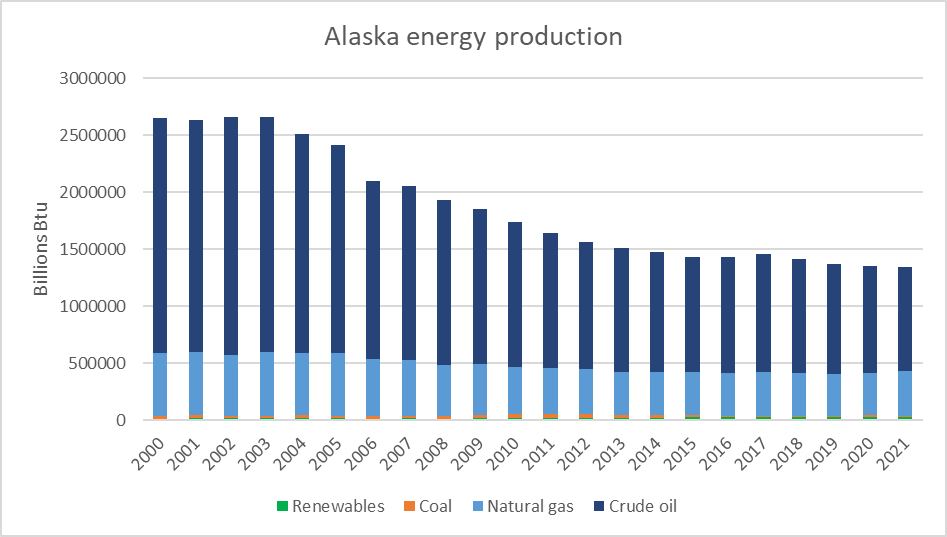
Figure 1 shows the domination of fossil fuels, especially oil, followed by natural gas and coal. However, production of fossil fuels did decrease by 50% between 2000 and 2021. Oil decreased the strongest (-56%), followed by coal (-38%) and natural gas (-29%). Whilst the production of renewable energy doubled, in 2021 it still represented only 1.76% of total energy production. Within this category, hydropower dominates (62%) followed by biomass (34%). Alaska has no nuclear energy.
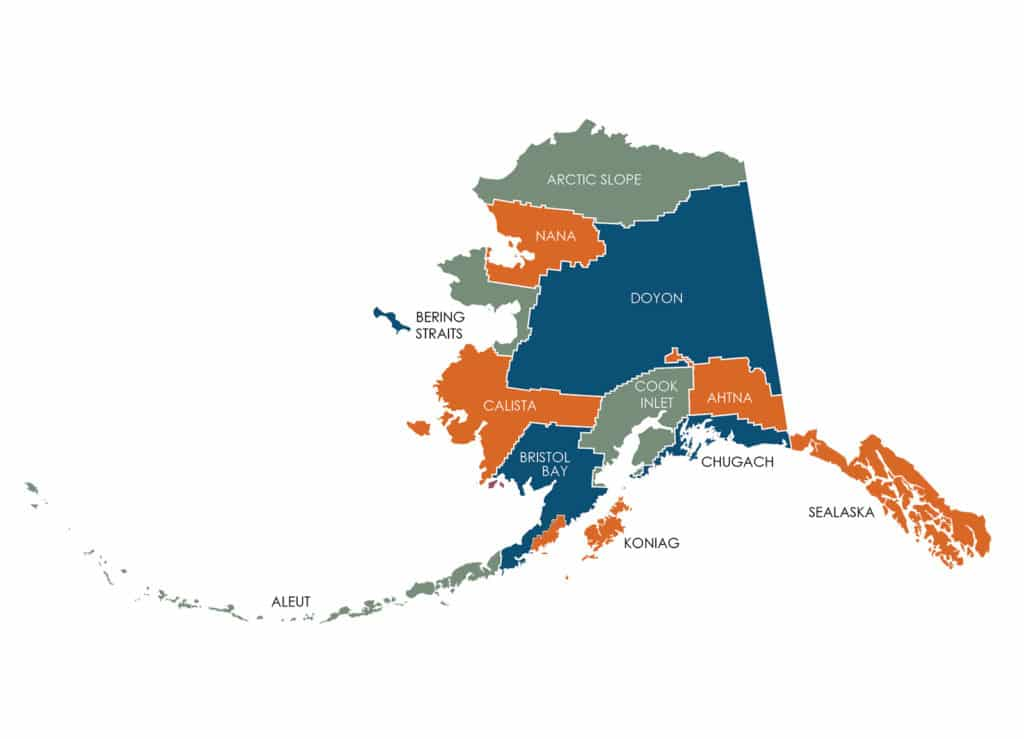
Three companies have dominated oil & gas production in Alaska: BP (54% & 76%), ConocoPhillips (34% & 5%) and Hilcorp (8% & 17%) [4]. However, in 2020 BP sold its Alaska business to Hilcorp [5]. Geographically, of the oil and gas produced between September 2000 and September 2022, 96.5% of the oil and 96.0% of the gas came from the Arctic slope with the rest coming mostly from the Cook Inlet in the south (Figure 2) [4]. It is in the former region that the National Petroleum Reserve (NPR) and the Arctic National Wildlife Refuge (ANWR) are located (see also figure 3) [6]. The NPR was originally created as a petroleum reserve for the U.S. Navy in 1923. In 1976, it was transferred to the Department of Interior and is thus federal land [7].
Negative impacts of O&G exploitation
However, all that oil and gas production described above has contributed to climate change of which the effects are also felt in Alaska. The process of exploiting fossil fuels has also had adverse effects on the environment such as a decline in beluga whales in Cook Inlet, changes in whale migratory routes, changes in distribution of caribou, damage to tundra vegetation, increased erosion, declining bird populations [10, 11, 12]. It is thus no surprise that environmental groups oppose oil and gas exploitation in Alaska [13]. But also local people are worried. The people of Nuiqsut, an area which lies within the oil fields, are increasingly concerned about pollution which is linked to various illnesses such as asthma and cancer [14, 15]. The Gwich’in Indians, who rely on caribou, see oil development as a threat to the herds and their culture whilst the Inupiat Eskimos, who hunt whales, have to travel further due to changed whale migration routes, thereby increasing risks. They are also worried about the real threat of oil spills which would have catastrophic effects [12].
The socio-economic importance of fossil fuels for Alaska
Yet there are also local people who are in favour of fossil fuel production. Last February, a company owned by the Iñupiaq and the non-profit Voice of the Arctic Iñupiat went to DC to argue in favour of the Willow project. They argue it creates jobs and revenue which then stimulates economic growth in their society and enables the development of key infrastructure [16]. The latter was echoed by a resident from Wainwright saying oil and gas revenue finances key services such as running water, flood control, health care, etc. He said that people in the village were divided on oil and gas development, which is further reflected in the presence of a group called Sovereign Iñupiat for a Living Arctic which actively opposed the Willow project [17]. Unfortunately, the fact remains that this sector is the primary driver of the state’s economy, accounting for most of the state’s funds (85% according to the state’s website) [18]. According to an industry commissioned study, fossil fuel production accounts for a quarter of all jobs (when including various indirect effects) [19]. Another reason local people would want to keep fossil fuel production is that every adult and child, who has lived in the state the whole year, receives an annual dividend from a fund derived from oil revenue [17]. In 2022, this was 3284 USD (3116,17 euros) [20].
Trump vs Biden
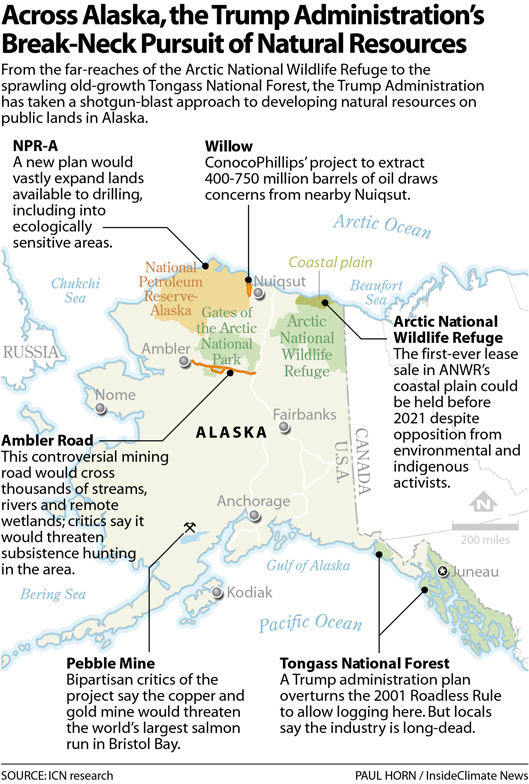
Given that 60.9% of Alaska is federal land, the federal government plays an important role [21]. Trump’s approach involved revoking several environmental protections and extracting as much as possible (Figure 3) [22]. On the other hand, Biden’s policy has been mostly about overturning Trump’s decisions [23]. Of the six major projects shown in Figure 7, four of them have been cancelled by the Biden administration: NPR-A [24], Arctic National Wildlife Refuge [25], Pebble Mine [26] and Tongass National Forest [27]. No final decision on Ambler Road has been made [28] while the Willow project has been approved [1]. Biden also revoked the permit for the Keystone XL pipeline [29]. Trump’s policy on predator control in Alaska, which allows hunters to bait and kill bears, and kill black bears and cubs and wolves and pups in their dens, has not been overturned despite years of efforts by environmentalists [30, 31].
Conclusion
The need to transition away from fossil fuels and towards renewables is beyond a doubt. Figure 1 has shown that this is underway, though very slowly, in Alaska. How this transition happens is clearly important to the people of Alaska. Some of them want to keep fossil fuel production as they depend on its revenue while others want to stop it due to its pollution. It highlights an important concept that not only applies to Alaska but to the whole world: the just transition. To get everyone on board, there is a need for strong state and federal policy including nature protection, retraining programs for fossil fuel workers, provision of essential services and most of all, something that is difficult in the US, a stable federal policy.


